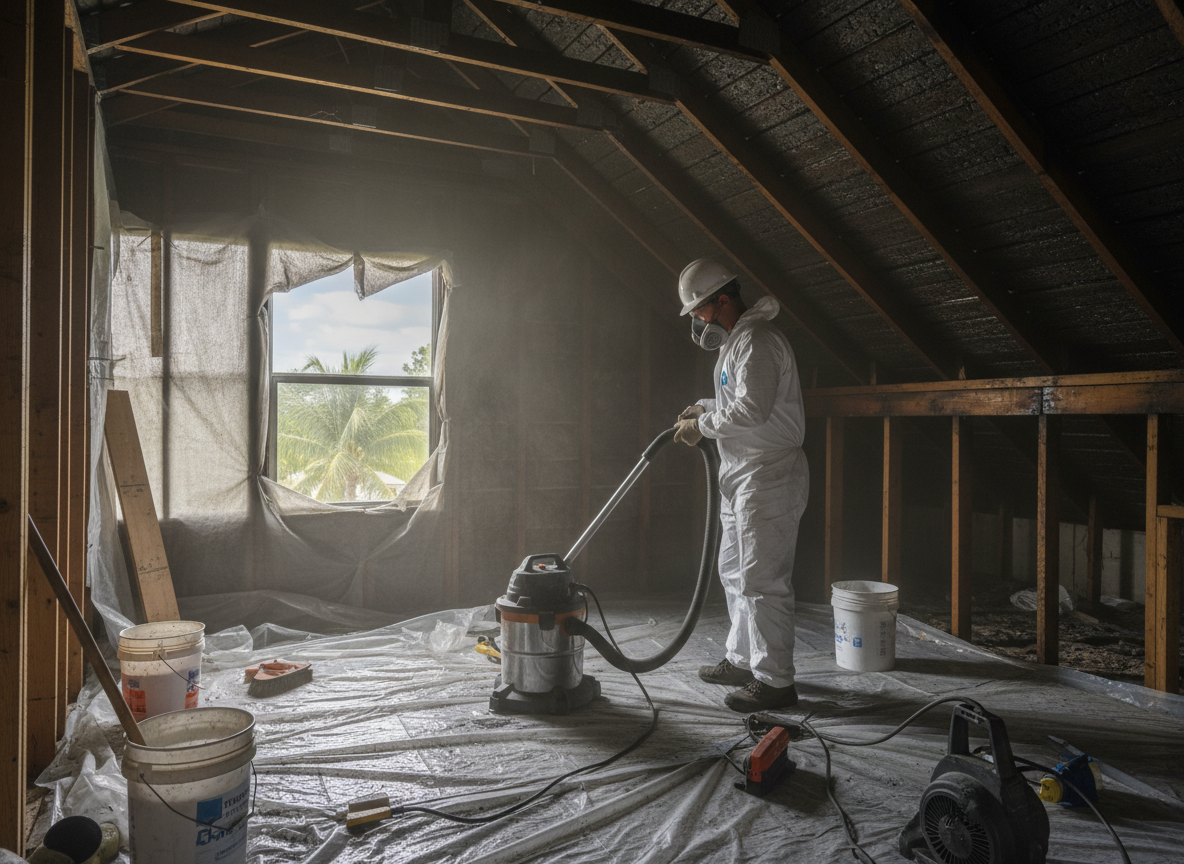
Surfside sits along the Orange County coast with mostly older single-story and two-story wood-frame homes built from the 1940s through 1970s. These structures often have open attics with minimal fire stops, allowing flames and smoke to travel quickly along rafters and into wall cavities. The mild Mediterranean climate with cool summers keeps humidity moderate year-round, which slows natural drying of soot-covered insulation and drywall but also limits rapid mold growth after water is introduced during suppression.
Restoration crews must account for salt-laden air that accelerates corrosion on metal fasteners and HVAC ducts once fire residues are present. Homeowners in Surfside and adjacent Seal Beach frequently discover that standard cleaning misses soot embedded in fiberglass batts and blown-in cellulose, requiring full removal rather than surface treatment. Local building codes in Orange County require updated smoke detector placement and proper attic ventilation after any fire event that affects more than ten percent of the space.
Edge cases include hidden ember travel into eaves facing Surfside Beach, where prevailing winds can push smoke deeper into neighboring Sunset Beach properties. Technicians inspect for compromised collar ties and ridge boards that may appear sound but have lost structural integrity from heat. All work follows current California Residential Code sections on fire-damaged assemblies, with documentation provided for insurance adjusters before any reconstruction begins.
Technician insight
In Surfside the thing that catches most people out with attic fire restoration is how the salt air from Surfside Beach has already started pitting the old galvanized straps and nails once heat and soot hit them. Homeowners assume the framing is fine because it looks solid from below, but we often find collar ties that snap during removal because the corrosion was hidden under years of dust. That forces extra engineering calls before we can close the ceiling back up.
Hidden ember travel into eaves
A small kitchen fire in a 1960s Surfside cottage sent embers into the attic through a poorly sealed vent. We found extensive char along the north eaves facing the beach plus smoke residue in every batt of insulation. After removing the damaged rafter sections and all insulation we installed new fire stops and ridge venting before reinsulating to current code.
How it works
- 1
Initial Assessment
Technicians arrive within hours, document visible char and smoke migration, and test attic framing for residual heat and structural weakness.
- 2
Containment and Safety
Plastic barriers and negative air machines isolate the attic while crews remove hazardous debris and verify electrical and gas lines are secured.
- 3
Material Removal
All affected insulation, charred wood, and contaminated drywall are extracted and disposed of according to local landfill requirements.
- 4
Cleaning and Odor Neutralization
HEPA vacuuming, soda blasting, and thermal fogging address embedded soot on remaining surfaces before new materials are installed.
- 5
Rebuild and Verification
New insulation, ventilation, and fire stops are installed, followed by final air quality testing and walkthrough with the homeowner.
Pricing
Upfront written quotes provided after on-site inspection; final cost depends on square footage affected, depth of smoke penetration, and whether structural members require sistering.